
The future of orthopaedic technology software – networked, intelligent and patient-centered
Orthopaedic technology is in the midst of a digital transformation. What began a few decades ago with paper documentation and manual processes is now developing into a highly networked ecosystem of intelligent orthopaedic technology software, cloud platforms, IoT devices and AI-supported applications. Digital orthopaedic technology is no longer a topic for the future – it is increasingly becoming the basis for modern care concepts.
It is not only the technology itself that is changing, but also the way in which patients are cared for. Networked systems, data-based decisions and modern software for orthopaedic technology are creating new opportunities for more individualized therapies, more efficient processes and higher quality care.
From analog processes to digital orthopaedic technology
The development of OT software shows just how much the industry has changed in recent decades. While paper documentation and manual processes used to dominate everyday life, CAD/CAM systems and PC-based applications later found their way into product development. Finally, mobile applications and cloud technologies marked the beginning of the use of software in healthcare and, at the same time, the networking of various players and systems.
Today, the focus is on topics such as artificial intelligence, real-time data for predictive care and interoperable platforms. Software is increasingly becoming a central component of modern supply chains.
The demands on modern orthopaedic technology software are increasing
Today, software for orthopaedic technology has to do much more than just documentation or device configuration. The requirements are growing both on a regulatory and technical level.
The key challenges include
- Regulatory requirements such as MDR, IEC 62304 or ISO 13485
- Data protection and cybersecurity in accordance with GDPR and IEC 81001-5-1
- Interoperability with ePA, FHIR and telematics infrastructure
- High usability despite complex processes
- Individual patient care
- Economic pressure in small and medium-sized companies
In particular, the combination of regulatory safety and intuitive usability determines whether digital orthopaedic technology is actually accepted and used efficiently in everyday life.
Why orthopaedic technology needs special software solutions
One of the biggest peculiarities of orthopaedic technology is that software is used directly in the care context – not at a traditional office workstation. Orthopaedic technicians often work under time pressure, in workshop environments or during direct patient care.
This places special demands on modern orthopaedic technology software. Applications must not only be technically reliable and regulatory safe, but must also function intuitively in everyday life. Decisive factors here include
- Clear information architectures and fast workflows
- Large touch targets and ease of use
- Robust offline functionalities
- Error-tolerant user guidance in day-to-day care
Added to this is the strong patient focus in orthopaedic technology. Many patients are older or live with physical limitations. Topics such as accessibility, contrast, font size and comprehensible navigation therefore play a central role – especially for companion apps, which are increasingly becoming the extended digital arm of care.
Standards such as WCAG or EN 301 549 are also becoming increasingly important in the development of digital orthopaedic technology, especially in direct patient use.
Networked systems create new possibilities
Cloud platforms and IoT technologies are fundamentally changing the way patients, orthopaedic companies, clinics and manufacturers work together. Devices can transmit condition data in real time, while mobile applications support remote care and continuous care.
This creates new digital processes:
- Remote service and digital maintenance
- Over-the-air updates for devices
- Central availability of patient data
- Automated documentation for PMS and vigilance
- Digital service and support processes
Standardized interfaces such as FHIR, HL7 or IHE also enable integration into existing hospital and healthcare systems.
Practical example: Networked prosthesis fitting in real time
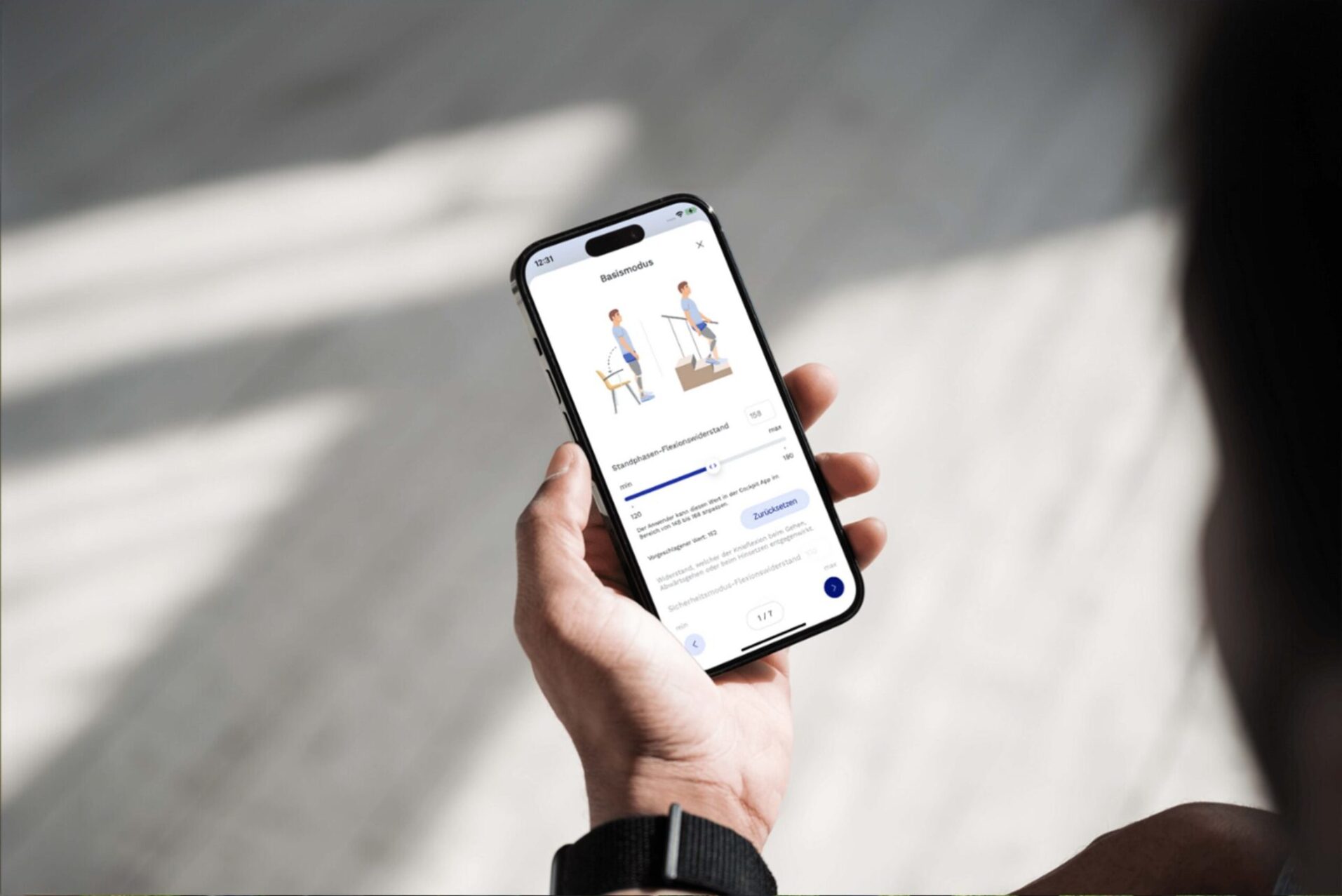
The connectgo.pro app developed in collaboration with Ottobock shows just how complex modern orthopaedic technology software is today. The mobile application supports prosthetists in adjusting microprocessor-controlled prostheses directly during fitting – in real time and directly in the patient’s movement sequence.
The project illustrates the special requirements of orthopaedic technology: software must not only be regulatory safe and technically reliable, but must also support biomechanical processes, be intuitive to use and interact seamlessly with hardware and sensors.
The full success story of the connectgo.pro app can be found here.
Artificial intelligence is changing orthopaedic technology
Artificial intelligence will have a lasting impact on orthopaedic technology in the coming years. Many applications are already technically feasible today – others are on the verge of widespread use.
The most important areas of application include
- AI-supported diagnostics
- Automatic analysis of 3D scans
- Adaptive prosthesis controls in real time
- Digital biomarkers for data-based therapy decisions
- Predictive maintenance and wear forecasts
- Automated support and PMS processes
The goal remains clear: more individualized care combined with greater efficiency and better quality.
Conclusion
Digital orthopaedic technology is increasingly developing into a networked overall system consisting of software, hardware, cloud and intelligent services. Modern orthopaedic technology software must not only meet regulatory requirements, but also function reliably under real-life care conditions.
It will be crucial to combine technological innovation with high usability, secure networking and genuine patient benefits. This is precisely where the future of modern software for orthopaedic technology lies.