
Authors:
Miriam Schulze, CEO of BAYOOMED
Julia Schliesch, Marketing Generalist at BAYOOMED
Digital endpoints—commonly referred to internationally as “digital endpoints”—have moved beyond the pilot phase. The Digital Medicine Society’s Library of Digital Endpoints now lists 601 digital endpoints from 93 sponsors.
What the collection also reveals is that more than just a technology decision lies between data collection and a regulatorily actionable endpoint. For sponsors who want to use digital endpoints in a clinical trial, this is the real question: not which device to use, but under what conditions the data collected with it will ultimately be valid.
Endpoint, Measurement Parameter, Biomarker
Three terms that are closely related yet distinct. The distinction between them is not determined by linguistic usage, but by what is specified in the exam syllabus.
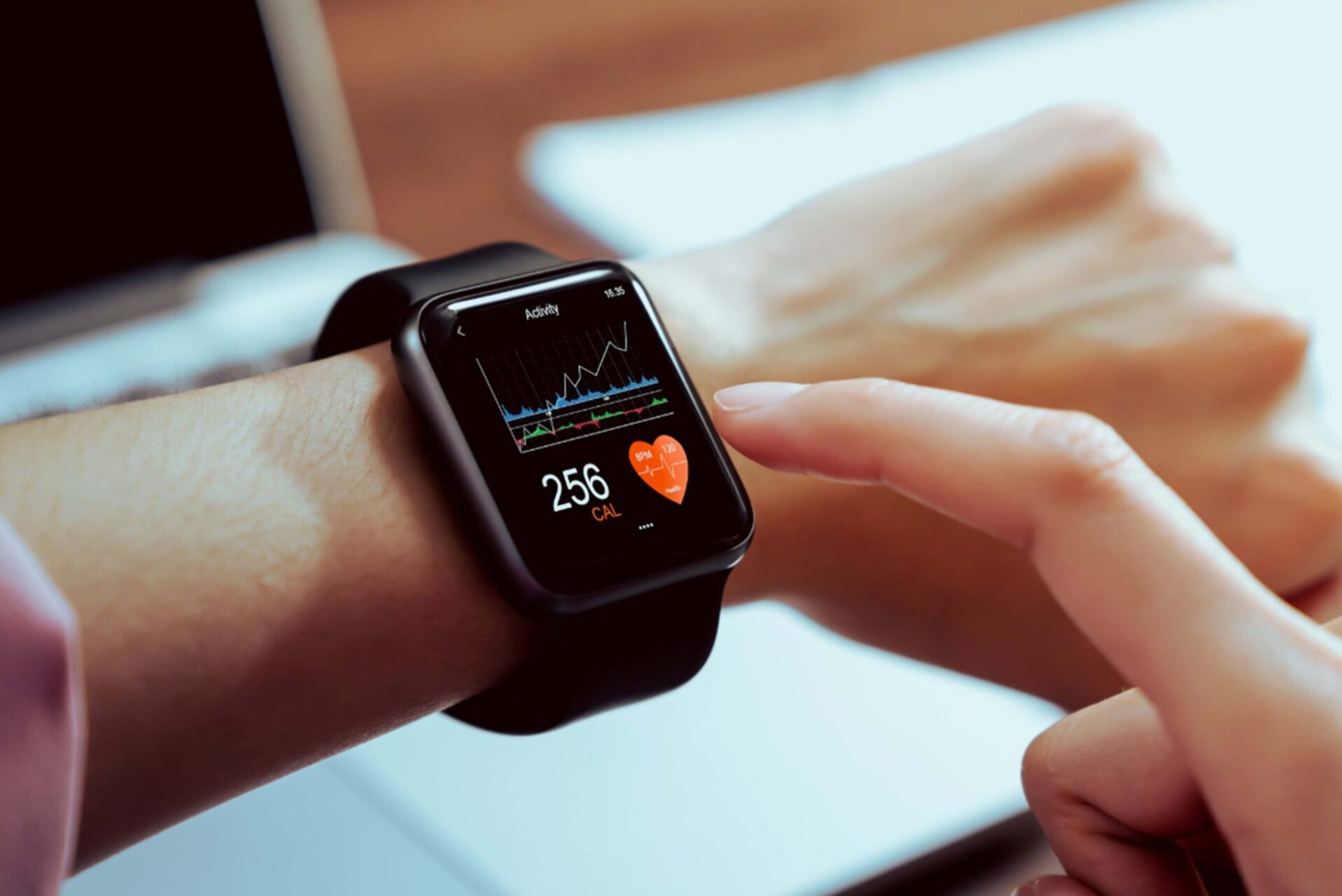
It is noteworthy what is missing from all of these definitions: the technology used to take the measurement. It is a measurement tool, not an endpoint. A wearable—such as a wrist-worn actigraph, a sensor patch, or a continuous glucose monitoring system—collects the data from which the endpoint is derived; in this case, the average daily step count over eight weeks. This distinction has practical implications: A study protocol that does not clearly distinguish between the data collection instrument and the outcome measure is vulnerable to challenge in regulatory review.
Primary, secondary, exploratory
What Is the Library of Digital Endpoints?
The collection is maintained by the Digital Health Measurement Collaborative Community (DATAcc), a joint initiative within the Digital Medicine Society (DiMe). It is deliberately not intended to be a comprehensive overview but is continuously expanded and updated. According to its own description, it is the only library that focuses specifically on industry-sponsored studies of new medical products. The latest update is from April 2026.
It is compiled through regular searches on clinicaltrials.gov, supplemented by entries submitted by the sponsors themselves. This results in a limitation that readers must keep in mind: Only information that has been publicly registered and reported is included. Any study that is not submitted and does not appear in the registry search is missing from the collection. A peer-reviewed analysis compared the 2023 entries against ClinicalTrials.gov and identified gaps in accuracy and completeness. Nevertheless, as a snapshot of digital endpoints in drug development, the Library remains the best available source.
Quality Standards for Digital Endpoints in Clinical Trials
Even more interesting than the entries themselves are the conditions under which an endpoint is included in the first place. Four criteria must be met:
These four points effectively define what constitutes a resilient digital endpoint—and thus serve as a benchmark against which one’s own project can be measured.
The fourth criterion deserves special attention because it requires sensor-based data collection—referred to in the literature as sensor-based digital health technology, or sDHT for short. Electronically recorded patient data is not sufficient for this purpose: ePRO is a valuable tool, but it is not a sensor. Anyone referring to a digital endpoint should therefore be able to specify which variable is being measured and by what means.
Why Digital Endpoints Succeed or Fail
The question of whether the investment pays off has now largely been answered. An analysis of 393 digital endpoints from 164 clinical trials shows that the investment generally pays off—through shorter trial durations, smaller cohorts, and faster decisions, with the most significant effects observed in cardiovascular diseases, CNS indications, and diabetes. The question is therefore no longer whether digital endpoints are worthwhile, but under what conditions they deliver on their promises.
The reason why traditional endpoints such as the 6-minute walk test continue to be relied upon in many indications—despite their known weaknesses—is rarely due to a lack of conviction. A new digital endpoint must first undergo verification, analytical validation, and clinical validation before it is regulatory-ready. This takes time and money, and there is no guarantee that the regulatory authority will ultimately accept it. Established endpoints, on the other hand, offer comparability with decades of historical data and clearly defined thresholds for clinical relevance—both of which are still lacking in many digital metrics. For sponsors, this uncertainty often outweighs the known weaknesses of the status quo.
When digital endpoints fail to deliver on their promises, the problem is rarely the technology. Four elements must align: the scientific research question, the operational data collection model, the analysis plan, and the evidence strategy. If any one of these is missing, the endpoint becomes vulnerable—regardless of how good the sensor is.
The surgical model is the aspect most often underestimated—and it is the only factor that cannot be corrected once the study has begun.
With digital endpoints, the risk shifts to the ongoing study
With a traditional endpoint, data collection takes place at the study center: during scheduled visits, under the supervision of study staff, and in a manner that is reproducible if necessary. Sensor-based endpoints, on the other hand, are collected continuously in everyday life. This is their main advantage, because they reflect the patients’ functional status under real-world conditions rather than in a controlled trial setting. However, it also means that data collection takes place outside the study center—over weeks, without supervision, and dependent on participants wearing and charging their devices.
This changes the typical type of error. The problem is rarely an incorrect measurement, but rather a missing one: insufficient wear time, interrupted device use, or gaps spanning entire periods. And these gaps cannot be filled in retrospectively. Anyone who discovers them only during the analysis has lost the endpoint.
How serious this is depends on the endpoint. For an exploratory endpoint, missing data is frustrating. For a primary endpoint, it can render a study unusable—after months of study duration and with patients who have contributed to the study.
With digital endpoints in clinical trials, data quality is no longer an issue for the analysis but rather one that arises during the course of the trial.
What This Means for the Study Monitoring
The Library shows which technologies are used in studies. What it does not show is how the data collected using these technologies remains reliable throughout the study. This leads to a requirement that has nothing to do with the sensor: adherence and data completeness must be visible while the study is in progress, not afterward.
Specifically, this means identifying data gaps early on rather than at the end of the study, continuously assessing data quality, detecting deviations in device usage by individual participants in a timely manner—and documenting all of this in a way that ensures the source data remains traceable and the documentation can withstand an audit.
That’s exactly why we built our Digital Clinical Trial Platform. It connects patients, study sites, sponsor teams, and the devices used in the trial, monitors adherence in real time, and highlights data gaps while they’re still addressable. This video shows what that looks like in day-to-day trial operations.
How is a digital endpoint recognized for regulatory purposes in Europe?
The library is based on clinicaltrials.gov and is therefore US-oriented. In Europe, there is a separate, voluntary process: the EMA’s “Qualification of Novel Methodologies,” which includes the “Qualification Advice” and “Qualification Opinion” procedures, supplemented by the traditional “Scientific Advice.”
An analysis of these methods for the years 2013 through 2022 reveals what sponsors are actually submitting: acceleration sensors most frequently, followed by glucose meters and smartphones. In terms of disease areas, disorders of the nervous system dominate, where digital endpoints primarily measure mobility and objective functional tests. This aligns with the indications in which their use yields the greatest economic returns.
Work is currently underway to make this process more structured. A project by the Digital Evidence Ecosystem & Protocols initiative, in collaboration with the European Federation of Pharmaceutical Industries and Associations (EFPIA) and the EMA, is investigating how evidence for qualification applications can be systematically prepared—including with a view to maintaining metrics that have already been qualified throughout their lifecycle.
The Stride Velocity 95th Centile (SV95C) in Duchenne muscular dystrophy demonstrates that this approach actually leads to the desired outcome. Since July 2023, SV95C has been qualified by the EMA as a primary endpoint—the first digital endpoint to achieve this status. This metric is measured using a wearable-based accelerometer that records the fastest steps in patients’ daily lives.
For sponsors with a European development program, this means that inclusion in a repository does not replace qualification. Anyone who wants to ensure that a digital endpoint is regulatory-compliant should plan for the EMA pathway early on.
Conclusion
The Library of Digital Endpoints showcases a field that has moved beyond the pilot phase. However, it also demonstrates that the difference between collected data and a robust endpoint lies not in the technology, but in study design, evidence strategy, and the ability to ensure data quality throughout the study.
When it comes to digital endpoints in clinical trials, the technology decision is the easiest part of this endeavor. It’s just not the one that causes the project to fail.
What you’ll find on our website
- Digital Clinical Trial Platform – Our platform for decentralized and hybrid trials: Monitor adherence in real time, identify data gaps early, and document source data in an audit-ready manner.
- Digital Biomarkers and DHT – How we develop solutions for collecting digital metrics: from sensor and wearable connectivity to integration into existing systems and validation of performance requirements.
- Digital Solutions for the Pharmaceutical Industry – Overview of our offerings for the pharmaceutical industry: from companion apps and cloud-based trial solutions to digital biomarkers and AI.
Sources
- Library of Digital Endpoints, DATAcc by DiMe
- Methodology and Inclusion Criteria for the Library
- DiMe Glossary
- Value in Health, Critical Analysis of the Library
- Assessing the Net Financial Benefits of Employing Digital Endpoints in Clinical Trials, Tufts Center for the Study of Drug Development
- Digital Endpoints in Clinical Trials: Building the Business Case for Systematic Adoption, *Nature Reviews Drug Discovery*
- Insights from the EMA on endpoints derived from digital health technology
- DEEP Project on EMA Validation, Scientific Reports 2026